


Yubico & Delinea link AI actions to human approval
Mon, 23rd Mar 2026
Yubico and Delinea have launched an integration aimed at tightening controls over actions taken by AI agents. It combines hardware-based human approval with identity governance and runtime authorisation.
The integration is intended to address what the companies describe as an accountability gap in agentic AI: organisations may be able to identify an AI agent, but still struggle to prove that a verified person approved a specific action carried out by that system.
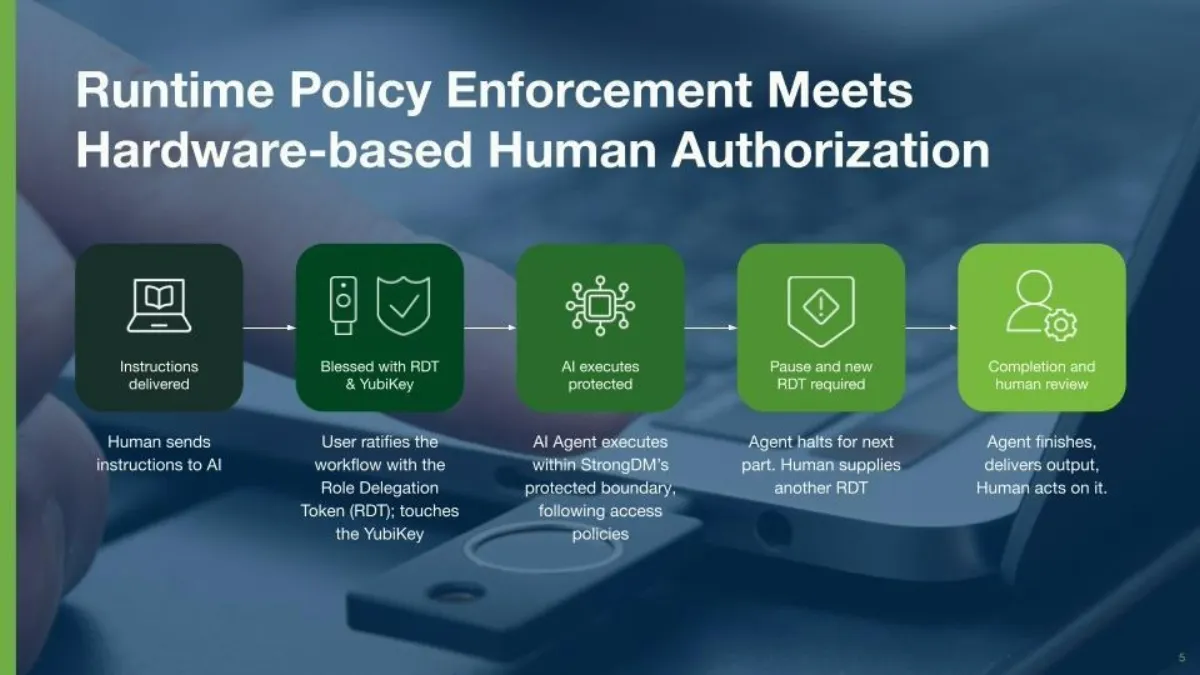
At the centre of the arrangement is Yubico's Role Delegation Token, a cryptographic authorisation mechanism backed by a YubiKey, now integrated with the Delinea platform. It also uses StrongDM's runtime authorisation tools and StrongDM ID, an identity layer Delinea says was built for AI agents.
The development follows Delinea's acquisition of StrongDM, which combined privileged access management with just-in-time runtime authorisation for human and non-human identities. Yubico adds a hardware root of trust designed to link a human approver to an automated action.
How it works
The integration targets environments where AI systems are taking on more operational responsibility. These include software development workflows, where AI coding tools generate, review and commit code, and operational settings where AI agents interact with infrastructure, databases and internal workflows.
In these cases, the system is designed to insert a human approval step at sensitive decision points. Examples include production deployment gates, privileged configuration changes and operations involving sensitive data.
Before an action proceeds, a verified individual must sign a Role Delegation Token envelope using a YubiKey. That signed token is then used with Delinea's governance and runtime controls to create a record tying the automated action to a named human approver.
The companies argue that software-only controls leave gaps because software can be impersonated, replayed or automated, making it difficult to show that a specific person was physically present and approved an action. A hardware token alone, however, does not provide policy evaluation, identity management or enforcement across large numbers of users and systems.
Growing identity issue
The move reflects a wider shift in enterprise security as businesses contend with a rapid rise in non-human identities. AI agents are becoming a larger part of day-to-day operations, yet access governance systems were largely built around employees, administrators and service accounts rather than semi-autonomous software actors.
Delinea says its platform provides centralised identity governance and just-in-time runtime authorisation, while StrongDM ID links agent identities to human sponsors. The aim is to give security teams a way to discover, govern and authorise access for both people and software agents across cloud, hybrid and on-premises environments.
Yubico's role is to provide what it describes as hardware-attested human authorisation. In practice, that means using a security key to produce cryptographic proof that a particular person approved a particular action within defined constraints.
The combined approach can be used to build audit trails across AI software factory workflows, from code generation to deployment, and across broader agentic operations. It can also support escalation gates backed by YubiKey approval for actions involving human, machine and AI identities.
Albert Biketi, Chief Product and Technology Officer at Yubico, said the challenge for organisations is not simply identifying an AI system but proving who authorised a consequential action.
"The hard problem in agentic AI security is accountability: can you prove a specific human approved a high-consequence action?
"Hardware attestation without runtime enforcement is a signature with no enforcement point. Runtime enforcement without hardware attestation is a policy gate with no proof of human presence. This integration with Delinea solves both sides."
Phil Calvin, Chief Product Officer at Delinea, said AI agents are becoming a significant new identity category inside large organisations.
"AI agents are quickly becoming one of the fastest-growing classes of identities in enterprise environments, yet most organisations lack the controls and accountability needed to govern what those identities can do.
"By combining Delinea's identity governance and runtime authorisation with Yubico's hardware-backed human authorisation, we create a trusted chain of control that ensures every high-risk action performed by an AI agent can be traced back to a verified human decision."