

OpenAI requires hardware-backed passkeys for cyber access
Mon, 13th Jul 2026
OpenAI will require hardware-backed passkeys for individual members of its Trusted Access for Cyber programme, affecting access to the company's most advanced cyber models.
Members who do not enable OpenAI's Advanced Account Security with a hardware-backed passkey by 1 September 2026 will revert to default model access, according to details released with the policy change.
The requirement applies to users in a programme that gives qualified security researchers and organisations access to advanced artificial intelligence tools for authorised defensive cyber work, including vulnerability triage and validation, malware analysis, detection engineering, and patch validation.
OpenAI is also tightening restrictions on high-risk entities and jurisdictions as part of a broader effort to limit misuse of advanced cyber tools. The move shows how identity controls are becoming a larger part of governance around access to sensitive AI systems.
Hardware-backed passkeys store authentication credentials on a physical security key rather than in software or cloud-based systems. As a result, the credentials cannot be copied or remotely extracted in the same way as passwords or some other forms of multi-factor authentication.
Security specialists have long argued that phishing-resistant authentication is necessary for high-value accounts because attackers increasingly target login processes with social engineering, fake websites, and session hijacking. Traditional protections such as SMS codes and mobile push notifications can be intercepted, redirected, or manipulated, while physical security keys are designed to verify both the user and the legitimate service before sign-in.
The policy marks a notable step for an AI company whose tools are increasingly used in security research and whose most advanced models may pose greater risks if accessed by unauthorised users. It also reflects a wider shift across technology companies towards stronger account protection for administrators, developers, and others with access to sensitive systems.
Security shift
OpenAI already uses YubiKeys internally to protect employees and infrastructure from phishing attacks. The latest change extends that approach to eligible external users in the Trusted Access for Cyber programme.
Yubico, which makes YubiKeys, welcomed the decision and said it set a precedent for the AI sector.
"We are introducing a new model for phishing-resistant security at scale for the AI ecosystem," said Jerrod Chong, chief executive officer of Yubico. "This partnership with OpenAI delivers the highest level of protection against phishing with a low-friction user experience. Ultimately, our intent is to drastically reduce the threat of unauthorised access to sensitive data in OpenAI accounts worldwide. We are proud to partner with OpenAI to deliver YubiKeys, the leading security key that offers the strongest way to use passkeys, increasing protection of sensitive user data for the AI frontier."
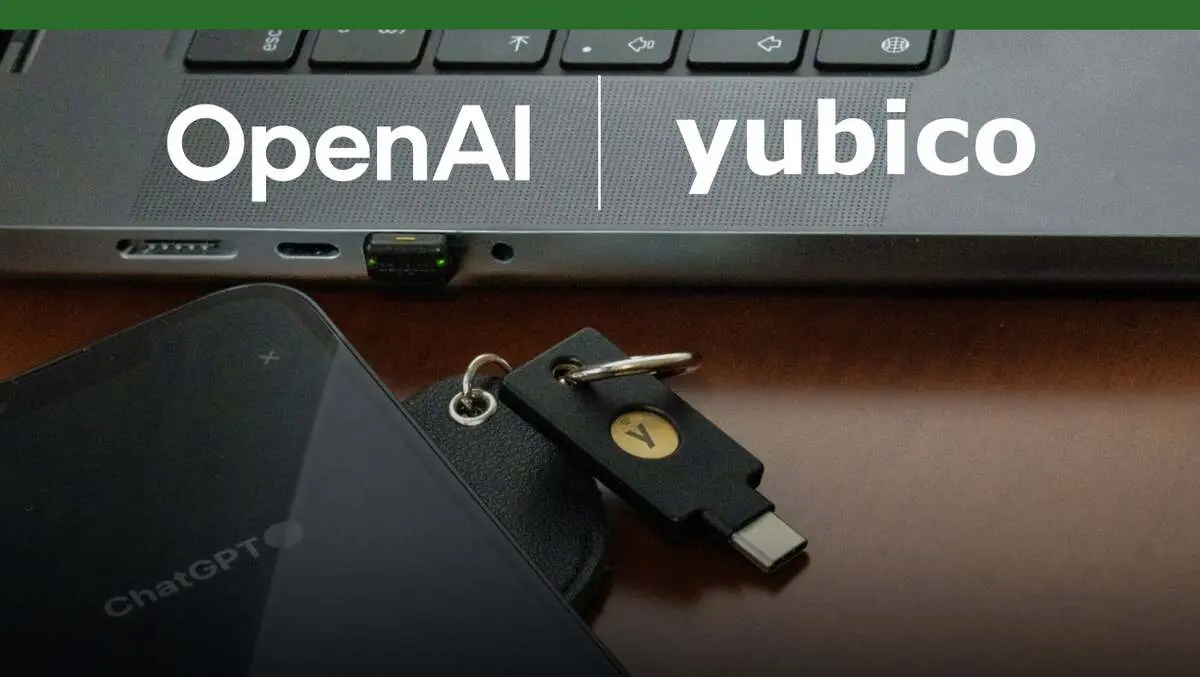
The arrangement includes a custom two-pack of security keys for existing OpenAI account holders at preferred pricing. One is a YubiKey C NFC device for authentication on compatible phones, tablets, and computers through USB-C or near-field communication. The other is a low-profile YubiKey C Nano designed to remain connected to a laptop.
Once enrolled, users can sign in through a passwordless process that does not rely on credentials being copied, intercepted, or synchronised between devices. OpenAI's Advanced Account Security programme also allows users to disable weaker fallback authentication methods that might otherwise create additional points of attack.
Growing pressure
The decision comes as criminal groups and other threat actors make increasing use of phishing kits, social engineering, and account resale markets to gain access to online services. In practice, compromised accounts can be used not only to reach data but also to exploit trusted user status within systems that restrict access to more sensitive tools.
That concern is sharper in cybersecurity settings, where approved users may handle malware samples, test detections, validate vulnerabilities, and examine patches. Restricting access to verified individuals with stronger authentication can reduce the risk of hostile actors gaining the same access through stolen credentials.
For AI companies, the issue is not limited to model safety in the abstract. It extends to the practical question of who can access the most sensitive systems and whether existing login methods are sufficient for tools that may assist in specialised security tasks.
OpenAI's decision suggests account security is moving closer to the centre of AI risk management, particularly where advanced models are made available to a select group of researchers. The change also underlines the growing role of hardware-based authentication in sectors where the cost of a compromised account is rising.
Members who fail to adopt the new requirement will lose access to OpenAI's most advanced cyber models and return to the default level of access.