


Malaysia chases AI hub status but workplace use lags
Thu, 12th Mar 2026
Malaysia is aiming to position itself as a leading hub in Southeast Asia's fast-growing artificial intelligence economy. However, new analysis suggests workplace use of AI still lags far behind what the technology could achieve, even in highly digital roles.
Investment in cloud computing, data centres and broader digital infrastructure is expanding the region's AI ecosystem. The Southeast Asian AI market is expected to more than double by 2030, and Malaysia's established semiconductor sector and growing digital economy have put it among the markets likely to capture a share of that growth.
Georg Chmiel, a board member of the World Digital Chamber and founder of Chmiel Global Advisory, said the opportunity also brings execution risks and distributional pressures.
"Malaysia has the ingredients to become one of Southeast Asia's AI leaders: strong semiconductor capabilities, a growing digital ecosystem and a young, tech-savvy workforce.
"But the real challenge now is execution. AI must not only boost productivity and innovation; it must also create opportunities across the broader economy. Without that balance, the region risks a two-speed digital future where some industries move ahead rapidly while others fall behind."
Usage gap
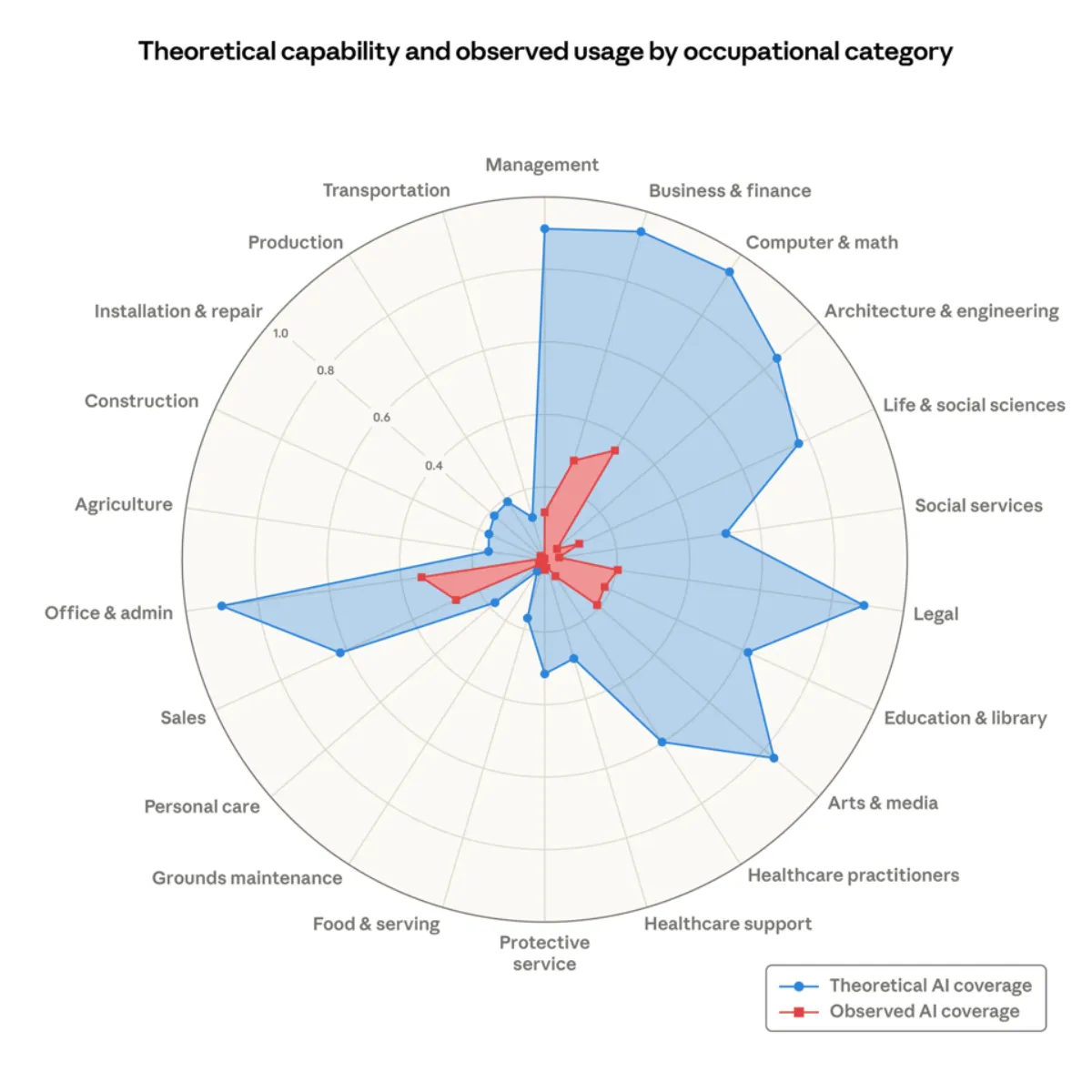
Research based on millions of real-world AI interactions suggests AI tools are already changing how some tasks are done, but adoption remains uneven. The study, by AI research company Anthropic, created an "observed exposure" measure, comparing tasks that large language models could theoretically perform with tasks where employees actually used these systems at work.
The analysis points to a persistent gap between technical potential and day-to-day use. In computer and mathematics occupations, large language models could theoretically perform up to 94% of tasks, but actual usage was closer to one-third of those activities.
"This tells us the full labour market impact of AI has not yet materialised," Chmiel said. "Even in highly digital professions, we are still in the early stages of adoption."
Current usage clusters around tasks described as "computing and creating", including coding, writing, research and analysis. These activities cut across many white-collar roles, from software development to marketing and professional services.
The gap matters for policymakers and businesses because it suggests productivity gains may arrive later than the rhetoric implies. It also signals that disruption may come in stages as organisations experiment with workflows, procurement, governance and staff training.
Supply chain stakes
The findings also have implications for how AI value spreads across economies. Markets that play a role in the AI supply chain stand to capture more of the economic value created by adoption, as semiconductors, advanced computing and digital infrastructure remain key inputs for many AI systems.
"Participation in the AI supply chain will determine which economies benefit most from the AI boom," Chmiel said. "This is where Malaysia has a significant strategic advantage compared with many emerging markets."
Malaysia has spent decades building electronics manufacturing capacity and a supplier network that supports chip-related industries. It has also attracted interest in data centre development as companies expand regional capacity for cloud services and AI workloads.
Even so, the observed usage gap suggests that spreading AI tools across domestic firms and sectors remains a separate challenge. Large organisations and technology-forward sectors often adopt earlier, while smaller businesses can face constraints around data readiness, skills, procurement and security.
Jobs and hiring
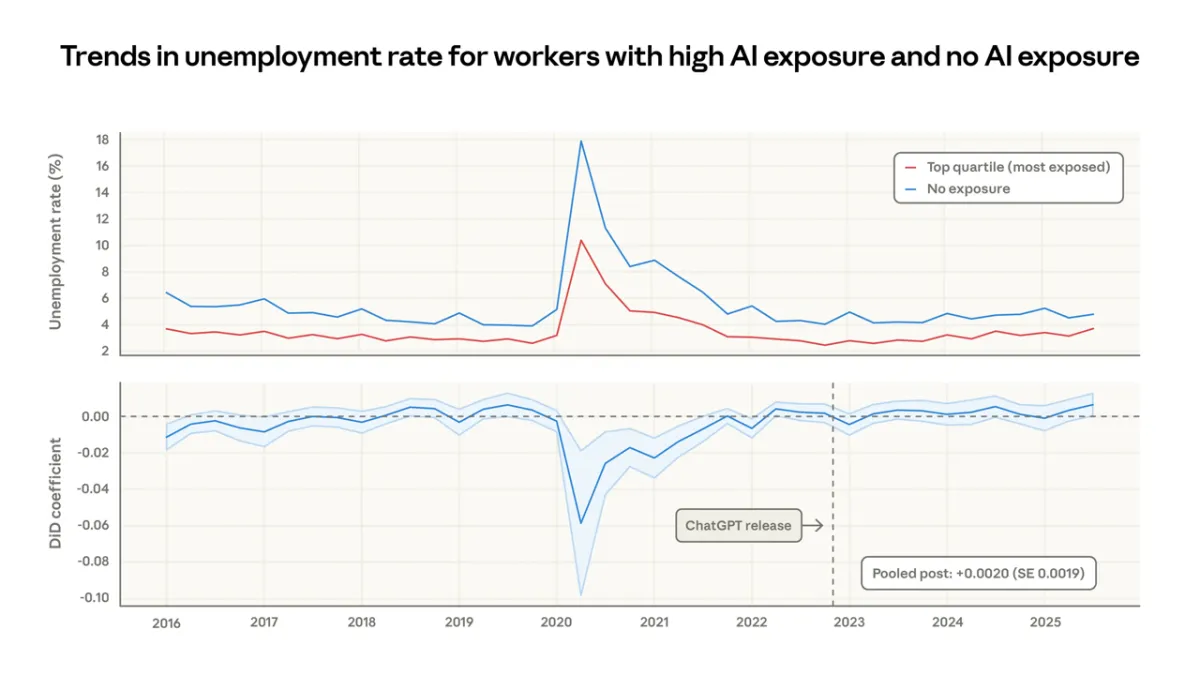
Concerns about job losses have dominated public debate about AI, but the Anthropic research suggests displacement may not be immediate. It compared unemployment trends for workers in occupations with high AI exposure against roles with no AI exposure, and found broadly similar unemployment rates between the groups.
Chmiel said the early effects are more likely to show up in how roles are designed and how companies hire.
"Technological shifts rarely eliminate jobs overnight," he said. "Instead, companies redesign roles, automate certain tasks and adjust hiring as technology evolves."
That pattern can affect labour market entry points for younger workers, particularly where junior tasks become fully or partly automated. It can also increase the premium on skills tied to oversight, quality control, domain expertise and the ability to use AI tools safely and consistently.
Security and standards
Governance and trust are emerging as competitive factors in AI adoption, particularly as organisations assess cybersecurity and data protection risks. The 2026 Thales Data Threat Report found that 71% of organisations across Asia Pacific ranked AI as their top data security concern.
Malaysia has signalled a move towards more formal governance, announcing plans for a national AI standards framework within the next year. The initiative sits alongside its ambition to become an "AI Nation" by 2030. A platform called My-AI Standards is expected to guide businesses, researchers and public institutions towards international best practices.
Private-sector use cases are also emerging. Property platform Juwai IQI is using AI in its operations, focusing on transparency and efficiency in the real estate market. BrioHR is using AI-based tools in human resources workflows tied to talent management and productivity.
Chmiel said policy, infrastructure investment and company activity are moving in the same direction.
"Malaysia has something a lot of countries don't: government policy, infrastructure investment and private-sector innovation all moving in the same direction. That alignment gives us a real shot at building one of the most trusted and resilient AI ecosystems in the region."
"The question isn't whether AI will change Malaysia's economy; it will. The question is who gets to shape that change. If we focus on talent, trust and homegrown innovation, Malaysia can be more than just a place where AI happens. It can be one of the places building it."