


How to choose the right identity verification partner in Southeast Asia
Wed, 17th Dec 2025
Southeast Asia's financial institutions are at a crossroads. The region is experiencing a digital boom, yet this growth is shadowed by a parallel surge in sophisticated, AI-driven identity fraud. As regulators from Singapore to the Philippines enact stricter mandates for biometrics and secure authentication, the pressure to choose the right identity verification partner has never been greater. A poor selection can lead to regulatory penalties, severe financial loss, and irreversible damage to customer trust.
This guide provides a strategic framework to cut through the complexity, helping you select a partner that not only meets today's compliance demands but also fortifies your business for the fraud challenges of tomorrow.
The Converging Storm: Fraud Sophistication and Regulatory Response
The digital threat landscape has evolved beyond simple forgeries. Fraudsters now deploy AI-generated deepfakes and synthetic identities to bypass traditional checks during customer onboarding (KYC) and account authentication. This has triggered a decisive regulatory response across the region, making robust verification not just a best practice, but a legal requirement for financial institutions and fintechs operating in Southeast Asia.
- Malaysia: Bank Negara Malaysia's updated e-KYC policy mandates technology providers to have their biometric and liveness detection modules independently assessed against international standards.
- The Philippines: Driven by the AFASA law, the BSP requires stronger authentication methods, moving away from vulnerable SMS OTPs toward biometric and behavioral biometrics.
- Singapore & Thailand: MAS has tightened 2FA requirements, while the Bank of Thailand promotes biometric adoption aligned with ISO and FIDO standards.
- Vietnam: Circular 50 sets a clear deadline for implementing FIDO-certified, biometric-powered verification for high-value transactions, with solutions requiring independent testing.
Failure to meet these evolving standards risks service disruption, hefty fines, and a critical loss of consumer confidence.
Beyond the Checklist: The Hidden Pitfalls of Supplier Selection
Many institutions approach vendor selection with a basic checklist, only to encounter critical roadblocks:
- The Expertise Gap: Evaluating advanced AI, biometric liveness, and FIDO certification requires specialized knowledge many internal teams lack.
- Integration Debt: Promised "plug-and-play" solutions often unravel when faced with complex legacy core banking systems, leading to unexpected costs and delays.
- Vendor Lock-in: Proprietary solutions can create long-term dependency, stifling flexibility and making it costly to adopt future innovations.
- The Compliance Moving Target: A solution compliant today may not be tomorrow. Partners must be proactive, not just reactive, to regulatory shifts.
These pitfalls underscore that selecting a supplier is not a simple procurement exercise - it's a strategic decision impacting security, agility, and customer experience for years to come.
A Framework for Future-Proof Selection: The 7 Critical Pillars
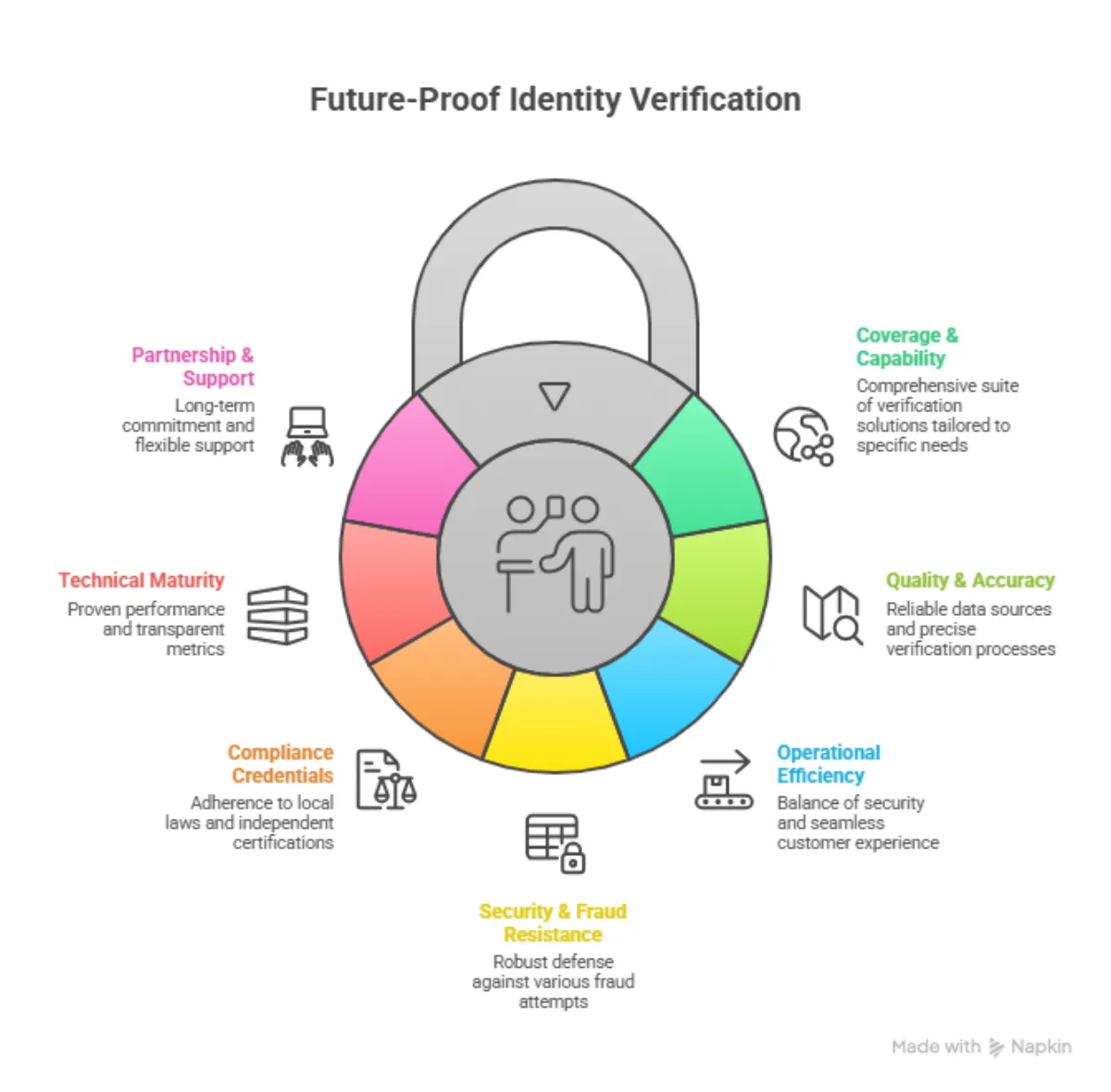
To navigate this decision, move beyond feature lists and evaluate partners through seven interconnected lenses:
- Coverage & Capability: Does the supplier offer a true end to end suite of identity verification solutions, from global document verification and biometric checks to watchlist screening and address validation, tailorable to your specific risk framework and customer journey?
- Quality & Accuracy: What is the source, depth, and global reach of the underlying data used for verification? Accuracy in de-duplication and cross-referencing is fundamental to reducing false positives and fraud slippage.
- Operational Efficiency: How does the solution balance robust security with a low-friction customer experience? Look for high automation rates and omnichannel support to accelerate onboarding without compromising safety.
- Security & Fraud Resistance: The solution must be a shield, not just a checkmark. Demand evidence of resistance to presentation attacks (deepfakes, masks), account takeover attempts, and integrated risk-based authentication that adapts to threat levels.
- Compliance Credentials: Require verifiable proof of adherence to local AML/KYC laws and data residency rules. Independent certifications (like ISO 30107-3 for liveness or FIDO Alliance certification) are table stakes for meeting regional mandates.
- Technical Maturity: Seek proven performance. Ask for detailed case studies, especially within Southeast Asia, and transparent performance metrics (e.g., fraud capture rates, throughput speed) validated by third-party assessments.
- Partnership & Support: Evaluate the supplier's commitment as a long-term partner. Do they offer dedicated regional support, proactive regulatory updates, and the architectural flexibility (e.g., APIs, cloud deployment) to grow with your needs?
Conclusion: Building Trust in a Digital-First Era
In Southeast Asia's competitive financial landscape, trust is the ultimate currency. Selecting the right identity verification partner is a foundational investment in that trust. It secures your operations against fraud, ensures seamless compliance in a dynamic regulatory environment, and protects the customer relationships that drive growth.
A partner like Melissa exemplifies the integrated approach required today. Melissa's identity verification solutions provide a cohesive platform combining global data quality, document verification, biometric checks, and PEP/watchlist screening. This enables institutions to tailor seamless, secure onboarding journeys that meet stringent KYC/AML obligations while deterring fraudulent activity. By leveraging accurate, up-to-date data sources and flexible integration, these solutions help businesses verify who their customers really are - efficiently and reliably.
The path forward requires moving from viewing identity verification as a compliance cost to recognizing it as a strategic enabler for secure growth. The right partner doesn't just help you pass an audit; they empower you to confidently embrace the digital future, turning identity security into a competitive advantage.