

Here launches location reasoning for AI spatial decisions
Fri, 22nd May 2026
HERE Technologies has launched HERE Location Reasoning, a product aimed at AI systems that need location-based decision-making in real-world settings.
The offering is designed to give AI models and agentic systems a dedicated layer for spatial computation, rather than relying on a large language model to resolve location questions on its own.
The approach targets a growing problem for companies trying to use AI beyond text generation and search. While language models can answer questions in natural language, they often struggle with tasks that depend on changing road conditions, traffic, turn restrictions, route compliance, and the practical constraints of moving people, goods, and services through physical networks.
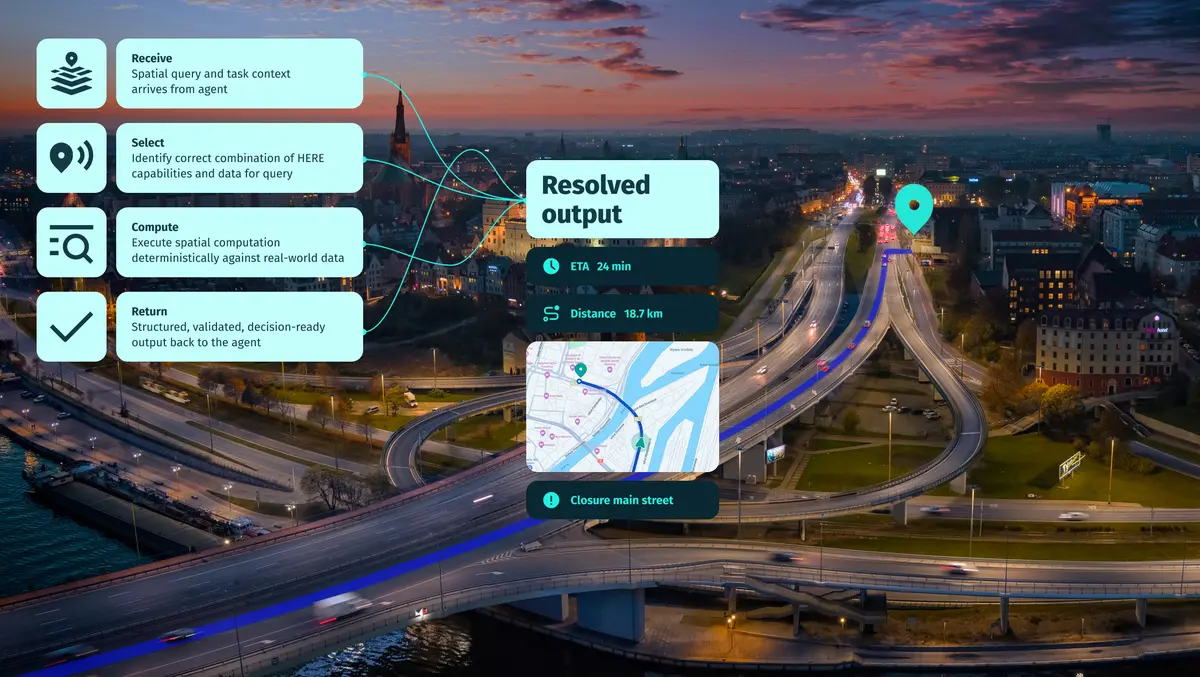
HERE says its system converts location-based queries into structured execution flows, then selects relevant map data, traffic information, road attributes, and network conditions to return consistent answers. It is pitching the product at businesses that want more predictable outputs when AI is used in transport, logistics, field services, and other operational environments.
Operational focus
The product is positioned as a way to reduce errors and costs linked to unreliable spatial reasoning. In practice, that could include route planning that misses restrictions, service dispatch decisions that require manual checking, or destination and stop recommendations that do not reflect live traffic or opening times.
Examples outlined by HERE include finding an electric vehicle charger within five minutes of a route, choosing a coffee stop without creating a detour, and checking whether a pharmacy can be reached before closing. The company also pointed to more complex uses, such as determining whether a truck can safely make a turn and calculating a route that meets vehicle and road constraints while accounting for live conditions.
For field service operators, the aim is to help assign the right technician without repeated human intervention. For fleet operators, the focus is on adjusting routes across multiple vehicles, delivery windows, and changing traffic conditions.
HERE says the product is designed to produce deterministic results, meaning the same inputs and constraints should lead to the same answer each time. That matters in workflows where inconsistency creates direct operational problems rather than simply a poor user experience.
Map data base
The new service sits on top of HERE's broader mapping and location data business. Its platform includes more than 68 million kilometres of mapped roads across more than 200 countries and territories, and its services are used in more than 238 million vehicles.
That scale is central to HERE's attempt to differentiate itself from general AI providers and application developers. Rather than competing on a broad consumer AI model, it is focusing on the underlying location data and traffic intelligence needed for industries such as automotive, logistics, and enterprise operations.
According to HERE, its road network data includes geometry, connectivity, traffic patterns, and road rules, and is updated using billions of real-world data points from multiple sources. The company argues that this gives AI systems a more reliable basis for physical-world decisions than open web data or static maps alone.
Another selling point is cost control. HERE says the product is intended to lower token usage and reduce unnecessary calls to location application programming interfaces, which could make AI deployments cheaper and more predictable to run in production settings.
It also says the service has been designed so that no personal data, user identity, query history, or attributable signals are retained or shared.
AI deployment
The launch reflects a wider shift in the AI market as businesses test whether language models can move from drafting content and answering questions to carrying out practical tasks. That has created demand for systems that can handle narrow but critical forms of reasoning with more certainty than a general-purpose model can provide on its own.
For companies in transport and logistics, spatial reasoning is one of the clearest examples. A route may look valid in theory but fail in practice because of a height restriction, a turn ban, congestion, vehicle-type rules, or time-sensitive access conditions. Those factors can change quickly and often require a system that combines current data with fixed network rules.
Christopher Handley, Senior Vice President of Product Management at HERE Technologies, said the company sees that gap as a barrier to broader use of AI in physical-world operations.
"AI can describe the world, but it cannot reliably compute how the world works. HERE Location Reasoning will change that," Handley said.
"As organizations move beyond basic, open data-driven queries to complex, real-world decisions, they are hitting a clear limit: AI models lack the data fidelity and capability to resolve spatial problems efficiently and cost effectively. HERE Location Reasoning aims to provide the missing execution layer, enabling AI systems to compute spatial outcomes accurately and consistently, so they can act in the physical world with speed, confidence and minimal oversight," he said.
HERE says the product is currently available through select customer and partner engagements.