

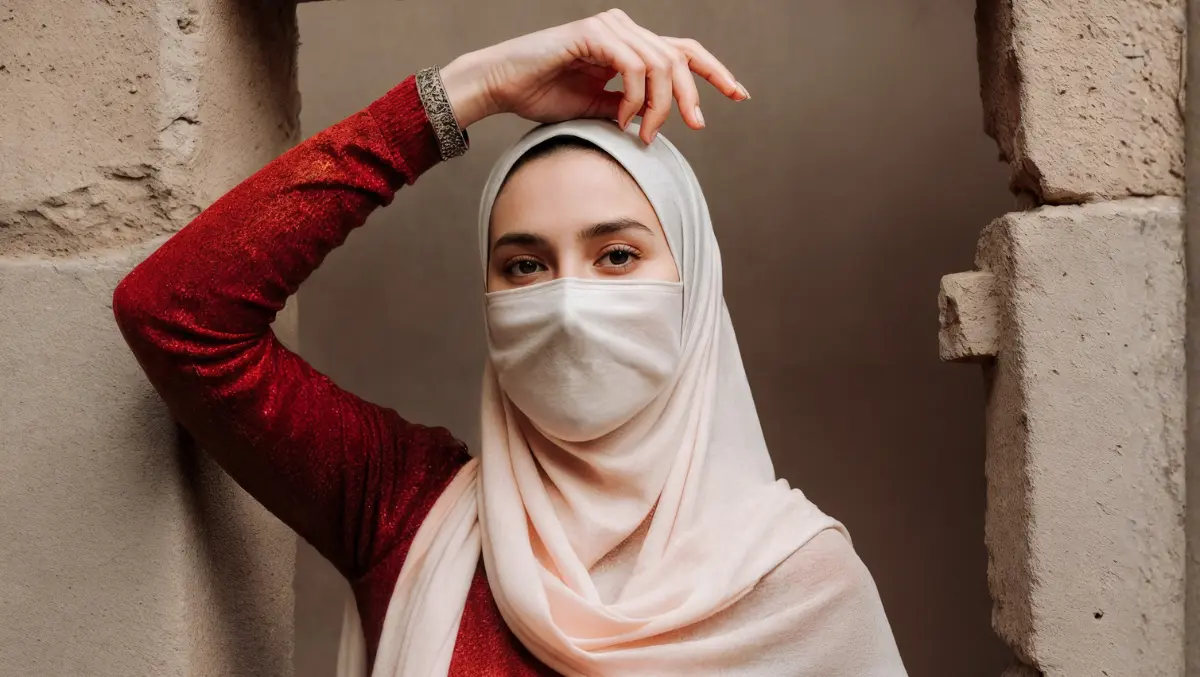
Face recognition for women in half niqabs: Common challenges and practical fixes
Mon, 2nd Mar 2026
Face recognition works best when a face is fully visible, well-lit, and front-facing. But production environments rarely look like a lab setup.
Across MENA, parts of ASEAN, and Central Asia, recognizing women wearing half niqabs is a standard requirement for face biometrics in banking apps, access control systems, smart city infrastructure, healthcare platforms, and digital onboarding flows.
However, partial face occlusion limits the visual data available to algorithms, making face detection and matching significantly more complex.
Here's our practical breakdown of why half niqabs challenge face recognition - and what developers and integrators can do to maintain high accuracy even when the face isn't fully visible.
Why Half Niqabs Are Hard for Face Recognition Models
Facial recognition might look simple at first: detect a face, extract key facial features, generate a biometric template and match it to a database. In reality, algorithms rely heavily on facial landmarks and texture patterns, including the lower half of the face, to make accurate matches.
A half niqab covers the nose and mouth, so several technical challenges arise:
- Partial Face Occlusion Cuts the Number of Available Features
Most recognition systems assume a mostly unobstructed face. When parts are hidden, algorithms lose access to critical identity cues such as cheek contours, mouth and nose shape.
Less visible data naturally lowers detection confidence and makes matching less reliable.
- Algorithmic Bias and Performance Gaps
Face recognition models trained on unbalanced datasets often underperform on underrepresented groups, which can result in higher error rates and unfair outcomes.
For developers, this means systems need specialized diverse, representative datasets with real-world variations including half niqabs in different styles, angles, and lighting to maintain consistent reliability.
Practical Fixes for Half Niqabs and Other Face Occlusion Scenarios
Partial face occlusion, like a half niqab, complicates recognition. To get reliable results, your system must be optimized for it. Here's how.
- Train on Occlusion-Representative Data
Training models on datasets that include faces with coverings - half niqabs, scarves, or partial masks - significantly improves robustness.
Assess models using occluded face benchmarks rather than only standard datasets. This gives a better picture of real-world performance.
- Expand Training with Augmentation
If real-world data is limited, generate synthetic occlusions through augmentation. For example:
-
overlay scarves or half niqab-style masks,
-
crop parts of faces,
-
simulate lighting variations.
This increases model exposure to diverse occlusion patterns.
- Focus on Available Face Regions
Even when the lower part of the face is covered, the eye region and upper facial landmarks remain valuable. Models that emphasize these stable areas tend to produce better recognition results under limited visibility.
- Use Multi-Frame Analysis
For video-based systems, don't rely on a single frame. Capture multiple frames, evaluate image quality, select the clearest shots, and run matching only on those.
3DiVi's Face Recognition for Half Niqab Scenarios
In regions where partial face occlusion is common, models trained primarily on fully visible faces often show a measurable drop in accuracy. Performance degradation is especially noticeable in verification and large-scale identification scenarios.
Drawing on extensive experience across Asian markets, 3DiVi trains its face recognition models specifically to handle partially covered faces, including those in half niqabs. In real-world tests, these models achieve up to 97%+ detection accuracy and 99%+ matching accuracy for half niqab-covered faces.
3DiVi's detection algorithm extracts up to 468 facial landmarks, which helps maintain embedding stability even when parts of the lower face are not fully visible.
Beyond core matching, the company develops supplementary biometric features to make face recognition reliable and secure:
-
Image quality scoring – filters out blurred or poorly lit frames before matching
-
Active and passive liveness detection – reduces spoofing risks
-
Deepfake detection – identifies AI-generated face manipulation
From a deployment perspective, 3DiVi's Face SDKs and APIs can run fully on-device. This ensures that biometric data does not leave the user's infrastructure, simplifying compliance in regulated industries and reducing backend requirements.
Summary
Recognizing faces partially covered by half niqabs is challenging because critical features are hidden and most datasets don't reflect these cases. This makes standard models less reliable in verification and identification tasks.
To address the gap, face recognition systems need training data that includes occluded faces, evaluation strategies that test real-world scenarios, and models designed to focus on stable, visible regions like the eyes and upper face. Combined with quality checks and liveness and deepfake detection, these measures ensure secure and accurate recognition - even when only part of the face can be captured.